
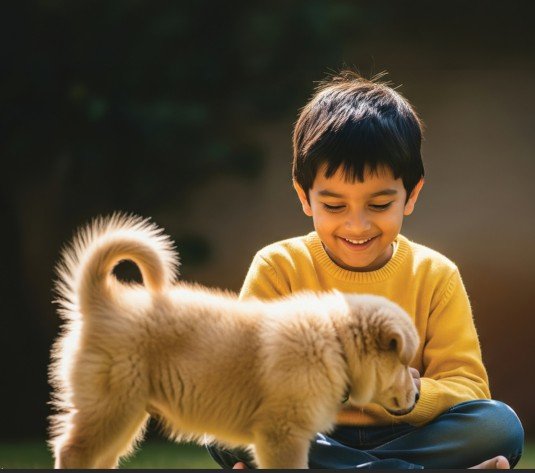
Having dynamic-looking breeds and designer dogs as pets is on the rise in the country these days. Many families have medium- to large-sized breeds like Labrador, Golden Retriever, Siberian Husky, German Shepherd, and Rottweiler, as well as designer dogs like the Golden Doodle and Malti-Poo, as pets. Surprisingly, some of these families also have kids in their house.
Sometimes, the kid and the puppy both grow together as they are of the same age. But the entire scenario changes when the family has grown-up kids (around 3 to 7 years of age) and the family brings a dog into their home. The children are super excited to play with the puppy, but they do not know the right way to do so. On the other hand, for the puppy, it is the very first interaction with the children, and therefore, the puppy also reciprocates in the same manner being a puppy.
Happy Homes Start with Safe Introductions
Pet Parents must be careful while introducing the puppy to kids for the first time, as one negative instance may impact the puppy and its behaviour towards children. It is equally important to teach the kids, how to play with dogs or how to approach a dog.
Children do not have the maturity to understand situations, as adults do; hence, there are a lot more chances of an accident with kids, as they can make your pet uncomfortable or irritable at times. Irrespective of the age and understanding of humans, most often dog bites take place because of humans and not dogs.
Children should be taught from the very beginning how to approach a dog for play. During pre-puppy counselling, we always suggest that the family, which is planning to get a pet, first assess themselves as to how much time and energy they would be able to spend on their pet, the environment, the number of children in the house, and walking the pet. Because a lot of misbehaviour from the pet is an outcome of boredom or unchanneled energy.
Secondly, it is always better to study the characteristics of the breed before bringing the pet home. For example, just because you can afford any breed, it doesn’t mean that you can bring home a Cane Corso in a 2 to 3 BHK Flat. A large breed needs a lot of space and exercise, and it is practically not advisable. Also, it will make the life of the pet miserable as he won’t get to manifest his natural behaviours of running around or guarding items.

Where Love Meets Responsibility
Once a puppy is brought home, the pup needs to be settled in with care. Always ensure that the puppy in his early days feels safe and secure in the house; this will eliminate the risk of the puppy being fearful. There are more chances of the puppy being aggressive in the future if it has been fearful since puppyhood. Always work on the self-confidence of the puppy and remember that training starts from the day you bring the puppy home.
Thereafter, introduce the children to the puppy under the supervision of an adult. Both the kid and the puppy should never be left unmonitored initially, as neither has the maturity to understand situations. Children should be taught to approach the pet gently from the side, and not from the front into its face directly. Always try to match the height of the pet by sitting on your knees on the side, never stand in front and loom over to pet him – they may find this intimidating.
It is not a Kid’s Play
The kids should also be educated not to disturb the pet while he is asleep or having his meal. As they say, “Let a sleeping dog lie.” If we follow this mantra, we can avoid a lot of accidents.
Whenever there are accidents in a house with kids, it is the poor pet who suffers the most, which is quite justified from a parents’ perspective, but the actual mistake is more often overlooked.
On the other hand, the children also go through the trauma of a dog attacking them, and it may stay with the kid for a lifetime.
Therefore, it is very important to teach the children the right manner to play and approach the dogs. By doing this, we can avoid such traumatic instances, and there will be harmony in the house.
Love Them, but Respect Them
Over the years, I have also seen that the adults in the house ignore a lot of signals given by the pet. To observe or understand these signals is not rocket science. For example, if you are petting or cuddling your pet and he growls, then you must immediately leave him without thinking anything. Because growling is the very first sign given by your pet, saying, “Please stop whatever you are doing. I do not like it.”
The moment you leave the pet, things are back to normal, as it ends only on a growl and your furry friend is happy.
We must teach the children to leave the pet as soon as they hear the growl, and in the first place, please do not do anything that makes the dog uncomfortable.
These days, pets have become an integral part of the family, and therefore they are involved in each function, celebration, festival, and whatnot, but always remember one thing: “At the end of the day, it’s a Dog.” Then we would be able to avoid most of the accidents.
Let us educate our children on how to approach and play with pets and create an environment where the pet and the kid are both happy playing with each other, without any accidents taking place. Because, at Pawfect Tails, we strongly believe that keeping a dog should be a pleasure and not pressure.