 Education is a powerful instrument that shapes a child into a responsible, informed adult. India has made remarkable progress in this area over the decades, producing globally recognized talent and inspiring generations of young minds. With rapid globalization, the rise of digital learning, and a highly structured academic environment, children today are more equipped than ever to access knowledge, build careers, and dream beyond borders. The system trains them to become problem-solvers, innovators, and future leaders.
But here lies a critical question: How many of these future leaders are being taught to care for their fellow human beings, for animals, and the planet?
Empathy Begins Early
 How many of them grow up to see a street dog drinking dirty water and feel a pang of empathy rather than indifference? Do they think, “That poor animal must be thirsty and has no choice,” or do they believe, “That’s just what street dogs do”? Do they realize that a bird building her nest on a concrete ledge is doing so because we’ve destroyed the trees?
These moments of observation, often overlooked, are where education is meant to guide not just the mind, but also the heart. And this is where Humane Education enters the picture.
 Humane Education is not an alternative to academic learning; it is its missing piece and it’s a complementary element. It aims to develop empathy, responsibility, and critical thinking skills to promote positive attitudes and behaviour toward all beings. It’s an approach that weaves compassion, empathy, and responsibility into the fabric of learning. It focuses on the deep interconnectedness of people, animals, and the planet, and helps children recognize that every action has consequences, not just for humans, but for all life.
Nurturing Empathy – Humane Lessons for Young Minds
A child who is taught humane education learns and knows the following –
- Those animals are not voiceless, but they speak in ways we must learn to understand.
- Why do dogs deserve more than scraps?
- How a baby elephant or a camel, or a horse was kidnapped from its mother and family and trained in the harshest of ways to give tourists joy rides.
- Why is a tree not just an object but a lifeline for so many creatures that have their homes in it?
- That nature is not an unlimited provider, but a delicate system that must be respected, protected, and restored.
- Why is kindness not a weakness but a strength?
Therefore, these children learn to stand up for those who cannot speak for themselves, whether animals or people and to use their voice to uplift and not to harm.
What is ‘The Violence Link’?
 Extensive psychological research has established a strong correlation between childhood cruelty to animals and future criminal behavior. This connection, often referred to as the “violence link,” underscores the critical importance of humane education. By fostering empathy and kindness, humane education plays a vital role in shaping compassionate individuals. Children who are taught to care for animals often begin by nurturing their pets at home. Over time, this care can evolve into a broader sense of responsibility, motivating them to protect stray animals and ultimately to show compassion toward all living beings who share our world.
STRAW India: Leading the Way in Humane Education
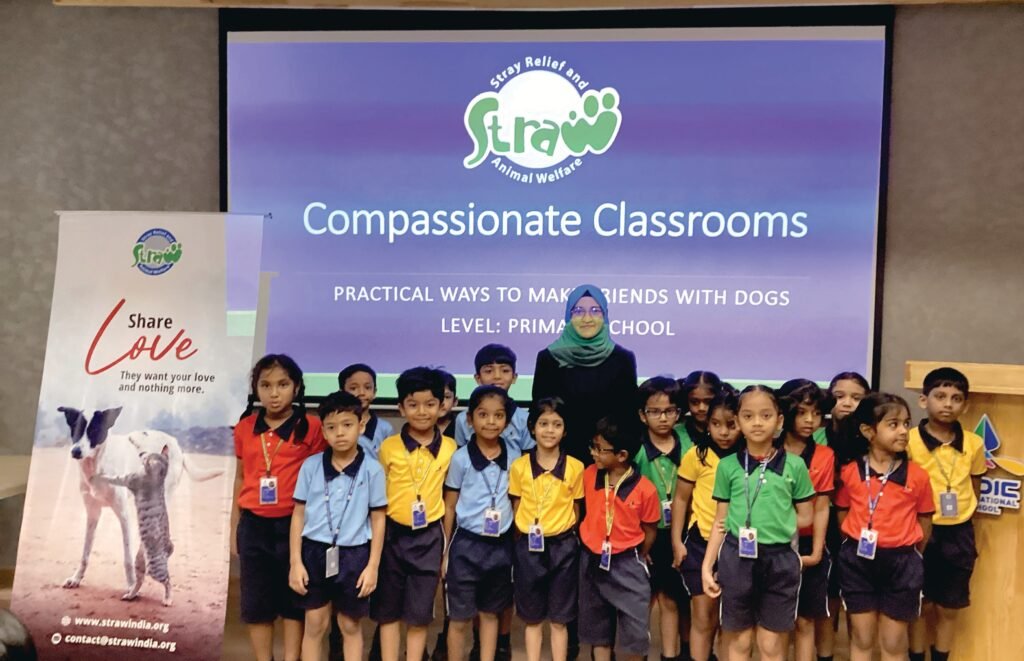
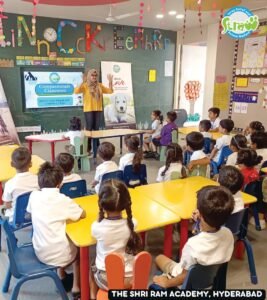
For over 12 years, STRAW India has been at the forefront of promoting humane education across the country. As a pioneering organization in this field, STRAW has reached more than 50,000 school and college students through its impactful programs—Compassionate Classroom, Echoes of Compassion, and the online initiative Stories of Kindness. These programs are designed to instill empathy, compassion, and a sense of responsibility toward animals and fellow human beings.
In addition to direct student engagement, STRAW India has made significant contributions to educational content by developing lesson plans for teachers’ training manuals and textbooks published by the Central Board of Secondary Education (CBSE) and a few other state education boards, further embedding humane values into mainstream education.
A Kinder World Begins in the Classroom
STRAW India’s methodology is both straightforward and deeply impactful. Using the Head, Heart, and Hands approach to learning, they aim to nurture not only intellectual growth but also emotional intelligence and a sense of responsibility. Their humane education programs go beyond traditional academics, fostering empathy and compassion in students.
Most importantly, these initiatives align with global priorities by addressing the United Nations Sustainable Development Goals—specifically, SDG 14: Life Below Water and SDG 15: Life on Land—highlighting the interconnectedness of education, empathy, and environmental stewardship.
Big Lessons for Little Hearts
 In a world that is growing increasingly polarized, where environmental degradation, animal cruelty, and social injustice often dominate headlines, humane education is no longer optional but essential. We cannot afford to raise another generation of leaders who are intelligent but indifferent, successful but selfish, brilliant but blind to the suffering around them.
Imagine a world where compassion is not treated as a soft skill but as a core value. Where children are not only taught how to calculate and memorize, but also how to care and coexist. Where success is not measured only by grades or pay checks, but by how we treat the most vulnerable among us. This is the world humane education dares to imagine and works tirelessly to build. Let us nurture minds that are not just smart, but also kind. Let us raise children who do not turn away from suffering but work to alleviate it. Let us give them not only knowledge but also wisdom. Because in the end, it is compassion that will decide the future of our world, not just intelligence.
(Vasanthi Kumar – Co-founder & Managing Trustee, STRAW India and Tanveer Khanam is Asst Manager, Humane Education at STRAW India.)